

The Assembly produces a range of documents which capture information about what goes on in the chamber:

Sitting calendar
The sitting calendar tells you what days the Assembly sits (meets in the chamber) that year. The Assembly sits about 13 weeks per year. This schedule is set at the end of the year before by a vote. Factors considered when choosing sitting dates include school and public holidays, and the budget cycle. The Assembly can change this schedule at any time by a vote.
The calendar is on our website (in both HTML and PDF) and available as a bookmark from at the Assembly building reception desk.
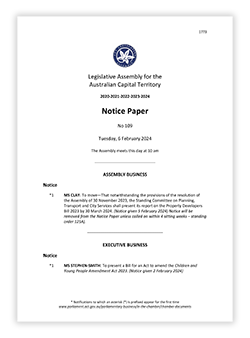
Notice paper
The notice paper is the agenda of the Assembly. It lists all active business including bills (draft laws), petitions, committees, and motions (proposals to do something). It is split into 3 sections, within which items are labelled either as notices or orders of the day:
- Notices are things the Assembly has not considered yet, and
- Orders of the day are things the Assembly has begun but not finished considering.
Notices become an order of the day when it is brought up on a sitting day. Typically, the Assembly works through items on the notice paper in the order they are listed.
The notice paper is kept on the Assembly website's chamber documents page.
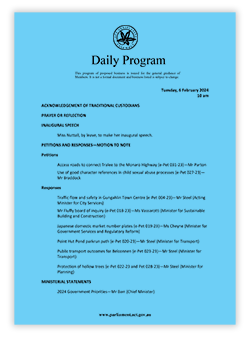
Daily program
The daily program (also called the ‘blue’ because of the colour paper it is printed on) is the best guess of what will happen on a sitting day. It is made up of items from the notice paper.
Because the Assembly can change what it is doing and when at any time during a sitting, it doesn’t have to follow exactly what is on the daily program.
The daily program is also kept on the chamber documents page.
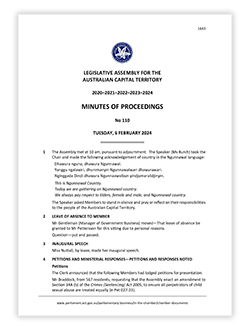
Minutes of proceedings
The minutes of proceedings are a technical record of what happened during an Assembly sitting. It contains information about every decision the Assembly made, like if any changes were made to bills, how long debates ran for, and what the result of any votes were. Importantly, it doesn’t include any of what was said during those debates.
It is prepared by Assembly staff at the end of each sitting day. It is kept on the Assembly website's chamber documents page.

Hansard
Hansard is the most well-known parliamentary document. It contains full reports of speeches made in the Assembly. It is not a verbatim transcript; it is edited to remove repetition, redundancy, and to correct mistakes. Any changes cannot fundamentally change or add to a speech.
Debates in the chamber are recorded and transcribed digitally, with Assembly editors who check the transcripts.
Hansard is available on it own Assembly sub-site.
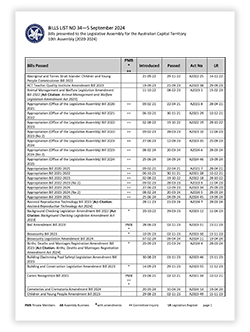
Bills list
The bills list has a full list of bills (draft laws) presented to the Assembly over its four-year term. It includes information about the date it was introduced, the dates it passed any stages of the law-making process, and its status before the Assembly. It also information about if a bill was amended, or if it did not pass. The bills list is updated after each sitting period.
The bills list has its own page on the Assembly website.
