

The law plays a central role in shaping how people are recognised in society. This factsheet explores how the Assembly and its predecessors changed laws affecting LGBT+ people.
Before self-government
Same-sex relations between men were illegal in the ACT from its creation in 1911. This law was inherited from New South Wales, whose Crimes Act 1900 continued to apply to the Territory after its transfer to federal control. Section 79 criminalised sexual intercourse between men, punishable by up to 14 in prison, regardless of consent. Same-sex relations between women were not criminalised, but attracted similar social stigma and discrimination.
Before self-government, the ACT was administered directly by the Australian government through a federal minister, who governed by making ordinances. In November 1976, the federal Attorney-General, Bob Ellicott, made the Law Reform (Sexual Behaviour) Ordinance 1976, which removed criminal penalties for consensual sexual activity in private between adults – regardless of sex. This made the ACT one of the earliest jurisdictions in Australia to decriminalise homosexuality.
Recognising relationships
The law recognises relationships in order to allocate important legal rights, such as next-of-kin status, inheritance, and medical and financial decision-making. For much of the 20th century, these protections were only available to heterosexual married couples. From the 1990s, the ACT Legislative Assembly introduced laws to extend these rights to same-sex couples, beginning with the recognition of non-marital relationships in the Domestic Relationships Act 1994.
Over time, the focus shifted to formally registering and recognising same-sex relationships.
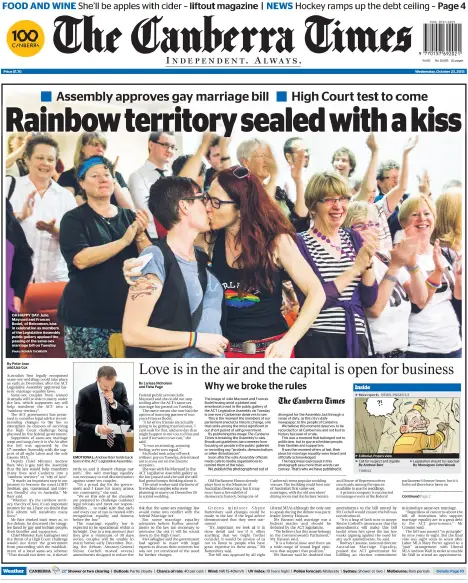
The public gallery after the Assembly passed the 2013 Act
Source: Canberra Times
The Assembly’s efforts to do this was constrained by constitutional arrangements that allowed only the federal parliament to make laws on marriage. The Civil Unions Act 2006 was disallowed by the Governor-General on the advice of the federal government, using a veto power contained in the Self-Government Act 1988. A second bill initially stalled after the threat of disallowance, but was later passed as the Civil Partnerships Act 2008.
In 2013, the Assembly passed the Marriage Equality (Same Sex) Act 2013 to allow same-sex couples to marry in the ACT. This law tested whether the federal parliament, by defining marriage in the Marriage Act 1961 as a union between only a man and woman, had left space for states and territories to legislate for same-sex marriage. In Commonwealth v ACT (2013), the High Court ruled that it had not and declared the ACT law invalid.
Same-sex marriage was introduced across Australia when the federal parliament passed the Marriage Amendment (Definition and Religious Freedoms) Act 2017 after a national postal survey.
Protecting who people are
Some laws passed by the Assembly also recognise and protect people’s identities. The Discrimination Act 1991 prohibits discrimination for many reasons, including someone’s sexuality or gender, while the Human Rights Act 2004 requires all ACT law respect a range of rights, including equality before the law. A 2016 amendment expanded the Discrimination Act’s ban on vilification (public incitement of hatred) to include sexuality.
This recognition extends to government documents too. The Births, Deaths and Marriages Registration Act 1997 allowed people to change their sex on official records. Amendments in 2014 removed the requirement for surgery to do this, and further changes in 2024 made it an administrative process only, removing the need for any medical treatment.
In 2023, the ACT passed the Variation in Sex Characteristics (Restricted Medical Treatment) Act 2023, the first law of its kind in Australia. The Act restricts non-essential medical intervention on intersex children, deferring such decisions until the person is able to make them for themselves.
Assembly members
Like other parts of Canberran society, LGBT+ people have also formed part of the Assembly’s membership. In 2006, Andrew Barr became the first openly LGBT+ person elected to the Legislative Assembly. When elected Chief Minister in 2014, he also became Australia’s first openly LGBT+ head of government.
Since 2020, the Assembly has also had one of the highest proportions (16%) of LGBT+ identifying members of any parliament in the world.
