

Explainer: How does the ACT have laws which predate self-government?
26 November 2022 | Canberra, Australia | Feature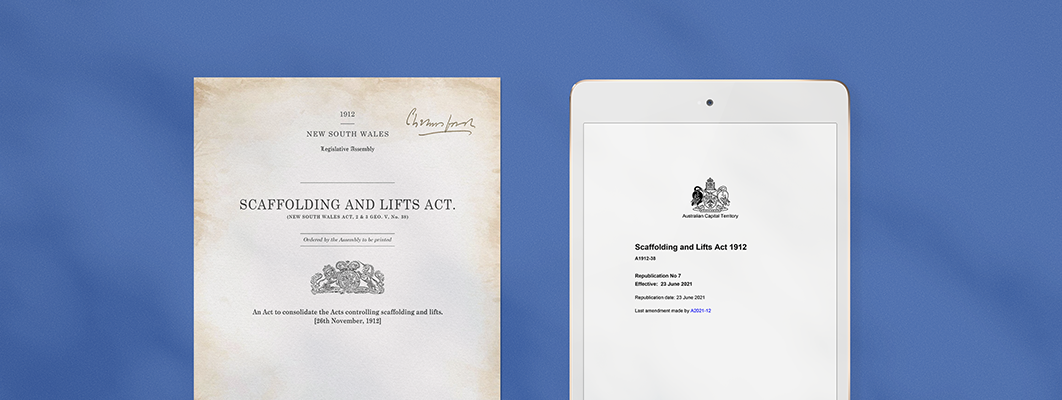
In democracies like the Australian Capital Territory, there are usually two sources of laws: acts of parliament and decisions of courts (called common law). The ACT didn’t have a parliament until self-government in 1989 – before then, a federal minister governed the territory by ordinance. But a quick look at the Legislation Register shows that we have laws on our books from before 1989.
So, how does the ACT have laws that predate self-government? There are two explanations.
Inherited laws
Before its creation in 1911, the ACT was part of New South Wales and subject to its laws. The 1909 and 1910 agreements to create the ACT decided that many NSW laws would stay in force after the area was surrendered to the Commonwealth to establish the national capital.
In 1911, this saw the new Territory inherit 55 years’ worth of laws made by the New South Wales parliament. It also meant the ACT inherited several much older imperial laws from the United Kingdom, which NSW had inherited itself upon self-government in 1856. These include laws from as far back as the 13th century!
The ACT also chose to adopt some NSW laws as their own after 1911.
The Self-Government Act 1988 (Cth) gave the ACT Legislative Assembly power to amend and repeal most inherited NSW and imperial laws as if they were their own. Today, only 10 laws of the NSW parliament and 16 of the British parliament remain in force in the Territory.
You can find these listed in Schedules 5 of the Self-Government Act and 1 of the Legislation Act 2001 (ACT).
Pre-self-government ordinances
Between 1911 and 1989, a federal minister responsible for the Territory governed by ordinance. Ordinances were laws made for the ACT by decree of the Governor-General (on the advice of the minister), a power that came from the Seat of Government (Administration) Act 1910 (Cth). These could be overturned by resolutions of either chamber of the Commonwealth Parliament.
While the ACT Advisory Council (and later, House of Assembly) provided advice to the minister, they had no law-making power and could not force a minister to follow their advice.
Most ordinances which were in force in 1989 were later converted to acts of the Legislative Assembly.
You can find out more about the sources of law and how laws are made in the ACT with this factsheet.